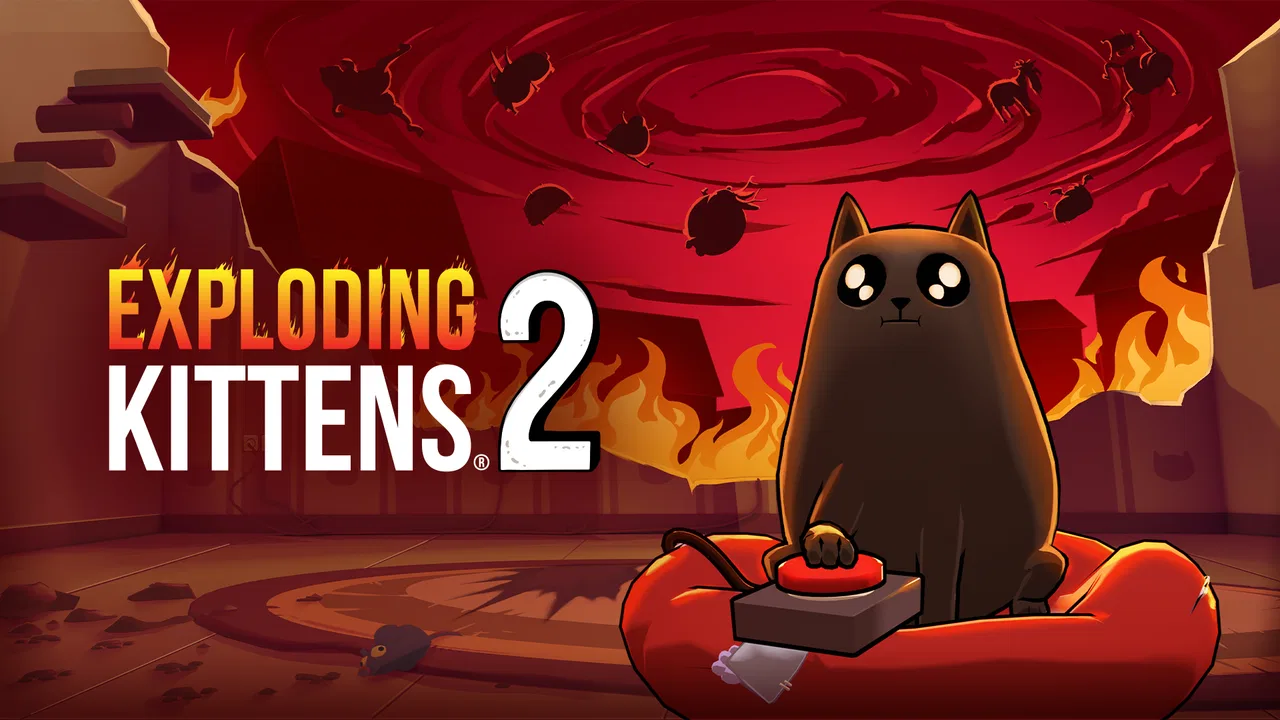
Exploding Kittens® 2
- 4.6
- Rating
- 50.00K
- Installs
- $4.99
- Price

 Analysis by App-foxy
I went into Exploding Kittens® 2 expecting a quick digital version of a silly card game, and that is exactly where its appeal begins. It is a board-category game from Marmalade Game Studio that turns a simple table activity into a compact cycle of risk, relief, laughter, and immediate revenge. You draw, react, try to avoid the explosive card, and then decide whether the last round was close enough to justify another one. That last decision is the real hook.
The game is aimed at players aged Everyone 10+, and I think that fits its tone well. It is playful rather than serious, but the tension can still become surprisingly sharp when a hand gets small and everyone starts watching the next draw. The digital format makes it easier to play when I do not have the physical deck nearby, although it also changes the social feeling of the original. Whether that trade-off works for you depends largely on how often you play alone, with friends, or with family.
How the first move creates immediate tension
I like how the opening turn makes the game’s central question clear without demanding a rules lecture: do I use a useful card now, or keep it for a worse moment? That choice is especially revealing when I’m playing with newcomers, because I can explain the immediate risk and let the consequences teach the timing. The next section looks at how the game makes those choices feel consequential from turn to turn.
You May Also Like

 Blood Strike: 2.5 Anniversary
Blood Strike’s Loadouts Turn Every Drop Into a Tactical Gamble
A close look at Blood Strike’s custom loadouts: how fast access to signature weapons reshapes its battle royale rhythm, rewards preparation, and narrows the gap between fights.

 Pandora - Music & Podcasts
Pandora’s Music Is Easy to Start, but Harder to Recover
Pandora’s strength is its low-effort path from a seed to a station. Its weak spot is how much confidence it asks you to place in connection, setup, and quiet recovery.

 8 Ball Pool
 Is Built on Rivalries, Rematches, and Routine
A close look at the rivalries, rematches, shared routines, and unanswered safety questions that turn a quick pool match into a persistent mobile community.

 Samsung Music
’s Quiet Strength Is Playing What You Already Own
Its reach comes less from spectacle than from dependable access to a personal library. That simplicity is both the app’s strongest retention engine and its ceiling.

 AccuWeather: Weather Radar
AccuWeather Review: A Quick, Clear Forecast for Everyday Decisions
For everyday plans, the best forecast is the one you can understand quickly. AccuWeather makes rain timing, radar, and local conditions easy to act on, with a few trade-offs.

 Hill Climb Racing
Why Hill Climb Racing Still Turns Crashes Into One More Run
A tiny car, a bumpy hill and one more upgrade: Hill Climb Racing keeps resurfacing because its simple chaos makes every near-miss feel personal.
More From Our News Desk
View All News


Simple actions, meaningful timing
The strongest part of the opening is that I do not need a long tutorial to understand the basic danger. The central action is familiar: cards let me influence the turn, protect myself, manipulate the order, or put pressure on another player, while the explosive card creates the threat that makes every draw matter. The rules are approachable, but the choices are not always obvious. Playing a useful card now may save me from danger, yet holding it can create a better escape later.
That timing question gives the game more depth than its cartoon presentation suggests. A new player can participate quickly by making intuitive choices, while an experienced player starts thinking about what the remaining deck might contain and how much information other players have revealed. I enjoy that the game does not ask me to memorize a large ruleset before the first interesting decision. The learning happens through consequences.
The first action also establishes the mood. A harmless draw can feel like a small victory because it keeps the round moving, while a dangerous draw immediately changes the table atmosphere. In a physical game, that moment depends on everyone handling the deck. Here, the interface delivers the result without setup, shuffling, or searching for missing cards. That convenience is a genuine advantage when I want a fast match rather than a full tabletop session.
Why the digital format works for short breaks
I can imagine using this game during a short break when I want something more interactive than a puzzle but less demanding than a strategy game. The individual decisions are easy to understand, and the explosive-card premise means a round has a clear emotional direction. I am not trying to build a complicated empire or remember a long campaign. I am trying to survive the next few turns and make the other players uncomfortable.
That makes it a good fit for people who enjoy party games but do not always have a group ready in the same room. It is also approachable for a family member who might avoid heavier board games. The age guidance makes sense because the humor and danger are presented in an exaggerated, comic way rather than as realistic violence.
There is a limitation, though. The game’s simplicity can feel thin if I want a long-form challenge every time I open it. Its pleasure comes from repeated short bursts, not from a deep campaign structure that I slowly master over many hours. I would not choose it as my only board game, especially if I prefer complex planning, resource management, or a large story-driven progression.
The first useful habit: do not spend every answer immediately
One of the most useful habits I developed was resisting the urge to play a helpful card simply because it was available. Early in a round, information is often more valuable than action. If I use my strongest response before the danger becomes clear, I may leave myself exposed when the deck becomes smaller and the pressure rises.
This is not a universal rule. Sometimes acting early is correct because it changes the order of play or gives another player a problem they must solve. The point is to treat each card as part of a timing decision rather than as a button that should be pressed at once. That small shift makes the game feel less random, even though uncertainty remains central.
The feedback rhythm: danger, relief, and comic punishment
The appeal depends on more than the danger itself; it comes from how quickly a turn can shift from confidence to alarm and back again. I find it useful to notice whether a move changed my options, not just whether I survived, since that helps separate a thoughtful decision from a lucky escape. That changing emotional pace is what gives the game its comic edge, and it leads naturally to the question of what makes a successful turn satisfying.
Every draw has a readable consequence
The core feedback rhythm is unusually clean. I take an action, the game shows me whether it helped, and the next turn begins with a slightly different balance of danger. A safe draw gives me relief but does not end the problem. A threatening result creates urgency. A successful counter feels rewarding because it changes the emotional direction of the round immediately.
That rhythm is why another session can begin so quickly. The game rarely leaves me wondering what mattered. I know when I made a clever choice, when I took a needless risk, and when another player’s move forced me to improvise. The comedy softens the punishment, but the punishment still has a purpose: it teaches me to pay attention to timing and probability without turning the experience into a lecture.
I particularly like the contrast between the bright, mischievous presentation and the sudden seriousness of a dangerous turn. The game can make me laugh at the same moment it makes me regret holding the wrong card. That combination is more effective than a purely competitive presentation because losing does not feel like a formal failure. It feels like the punchline of a bad decision.
Randomness is part of the appeal, and also the main weakness
The game’s luck is not something to work around completely. It is the engine of the experience. Even a careful player can be caught by an unfortunate draw, and a player who appears doomed can survive with the right response. That unpredictability keeps casual matches lively and prevents every round from following the same script.
At the same time, players who want outcomes to reflect skill almost every time may become frustrated. My decisions influence the odds and the timing, but they do not remove uncertainty. A strong play can still be followed by a bad result. I see that as acceptable for this particular design, yet it is an important reason not to treat the game like a serious competitive strategy title.
The best way to approach it is to judge decisions over several rounds rather than one unlucky moment. If I focus only on whether I survived the latest draw, the game can feel arbitrary. If I notice whether I preserved options, read the pressure correctly, and forced difficult choices onto others, the strategic layer becomes easier to appreciate.
How it compares with other board games
Compared with traditional chess or a deep digital board-game adaptation, this is much faster to learn and far less concerned with perfect information. I do not need to calculate a long sequence of moves. Compared with a quiet solitaire card game, it has more direct tension because the danger can be redirected toward other players. Compared with a physical party game, it offers convenience and instant setup, but it may not reproduce the same feeling of passing cards around a table and watching friends react in person.
That comparison helped me understand the right audience. If I want a quick, mischievous game with a strong push-your-luck feeling, this is a better choice than a slow strategy board game. If I want a calm solo activity or a highly skill-driven contest, another category will probably serve me better. Its identity is built around shared suspense and sudden reversals, not around quiet optimization.
What counts as a reward beyond simply surviving
Survival is the clearest payoff, but I also value the small sense of control that comes from preserving a response or leaving another player with an awkward choice. In a casual group, those moments can be more memorable than winning outright, especially when everyone understands how the pressure moved. The next section considers why those modest rewards can be enough to bring me back without needing a larger prize.
Relief is the immediate reward
The first reward is emotional rather than material: I survive a dangerous moment. That may sound small, but the game makes it satisfying because the threat is easy to understand. When I avoid the explosive card or use a response at exactly the right time, the result feels earned even when luck played a role.
The second reward is control. A good turn does not merely keep me alive; it can leave another player with fewer comfortable options. Redirecting pressure, changing the order, or forcing someone to make a risky choice creates a sense that I am shaping the round rather than waiting passively for fate. Those are the moments that make me want to replay instead of treating the game as a one-off novelty.
There is also a social reward in watching a confident plan collapse. In a group setting, the most memorable moment may not be my own survival but the instant another player realizes that their carefully saved response is no longer useful. The digital version can deliver that drama efficiently, although the experience is naturally stronger when the people involved are actively reacting together rather than silently taking turns.
Small purchases deserve attention
The game costs $4.99, and it also includes in-app purchases ranging from $0.99 to $9.99 per item. That pricing structure is worth considering before downloading. I prefer to decide in advance whether the base purchase already matches what I want, rather than letting optional items influence how I play or how much I spend.
For a player who enjoys the central loop and expects to return often, the initial price may feel reasonable because the game is designed for repeated short sessions. For someone who only wants to sample the idea once, the cost makes it less suitable than a free alternative. I would also recommend setting a personal spending limit if younger family members use the device, even though the game’s age rating is Everyone 10+.
The important trade-off is not simply price versus free. A free board game may be easier to try, but it may also rely more heavily on interruptions or a different progression model. Here, I would judge the purchase by how much I value quick access to this specific explosive-card loop. If that loop already sounds repetitive to me, no extra content or customization is likely to solve the basic mismatch.
Practical advice for playing with mixed experience levels
When I play with people who know the game better than I do, I find it more enjoyable to focus on one decision at a time instead of trying to imitate advanced tactics immediately. The useful question is not “What would an expert do?” but “What danger am I responding to, and what options will I lose if I use this card now?” That keeps the game readable and helps new players improve without slowing down the round.
For a family session, I would explain the basic danger first and let the first round act as the tutorial. The game’s feedback is clear enough that players can learn from a mistake without stopping to study every possibility. For a group of experienced players, I would expect more bluffing, hesitation, and deliberate pressure. The same rules support both moods, but the social energy determines whether the match feels light or fiercely competitive.
The session reset and why I keep drawing again
A fresh round gives me room to test one adjustment rather than dwell on a loss: hold a useful card longer, or take a different risk when the pressure changes. That makes the reset practical for short sessions, though it cannot make repeated turns feel endlessly new. The important distinction is whether I’m returning for that quick decision-making loop or hoping for a long-term progression system.
Loss does not end the appeal
The reset is central to the design. A round can turn against me quickly, but that loss also clears the emotional slate. I am not carrying a complicated campaign failure into the next attempt. I can immediately test a different approach, save a response longer, or take a more aggressive line. The short reset makes defeat easier to accept and keeps the game from becoming exhausting.
This is where the action-feedback-reward cycle becomes complete. I act, receive a clear result, enjoy the relief or laugh at the punishment, and then return to the starting point with one fresh lesson. The reason another session begins is not only that the game is short. It is that the previous round leaves an unfinished question: would I have survived if I had waited, redirected the threat, or trusted a different read of the situation?
That question is strong enough to carry repeated sessions for a while. It is weaker for players who need permanent progression to stay interested. I do not see this as a flaw in isolation, but it does define the game’s limits. The reset is excellent for casual replay and less compelling if I expect every session to unlock a major new layer.
When repetition starts to show
After several rounds in one sitting, I can feel the structure becoming familiar. The same emotional pattern—safe moment, rising danger, emergency response, sudden defeat or survival—remains enjoyable, but it can lose impact if I play continuously without a social reason to continue. My solution is to treat it as a game for short visits rather than an endless marathon.
That makes it especially useful for filling gaps in the day or adding a quick activity to a gathering. It is less convincing as a substitute for a full evening board-game experience. If I want a game that steadily expands its rules, tells a substantial story, or rewards long planning, I would choose something else. The reset is a strength only when I want the next round to feel familiar but not identical.
Device and purchase expectations
The game supports devices running Android 7.0 or later, and the current version is 1.0.0. Those details matter if I am installing it on an older phone or tablet. I would check compatibility before paying, especially when the device is used by several family members and the game may be shared between screens.
It has passed the fifty-thousand-install mark and holds a 4.6 average from around three thousand one hundred ratings, with roughly four hundred sixty reviews. That gives me some confidence that the game has found an audience, but I would still weigh those figures against my own preference for luck-driven party games. Popularity cannot change the fact that the central experience depends on enjoying sudden reversals.
My verdict on the complete loop
I judge the complete loop by whether its quick decisions, sudden reversals, and easy restart suit the way I want to play that day. For a lively short game with friends or family, that combination works for me; for a long strategic challenge or a reliably skill-determined outcome, I’d choose something else. The final section weighs those trade-offs and makes clear who is most likely to enjoy it.
Who should play it
I recommend Exploding Kittens® 2 to anyone who wants a compact board game built around risk, reaction, and comic tension. It is a particularly good fit for casual groups, families with older children, and players who want a digital option for a familiar card-game style without preparing a physical table. The first move is easy to understand, the feedback is immediate, and a lost round rarely feels like a reason to stop permanently.
I also think it suits people who enjoy learning through mistakes. The game does not require me to master a complicated system before I can make an interesting choice. I can begin with basic survival, then gradually improve how I conserve responses, interpret danger, and pressure opponents. That progression comes from my understanding rather than from a long explanation.
Who should skip it
I would skip it if I dislike luck deciding important moments, if I want a peaceful solo board experience, or if I expect a large strategic campaign. I would also hesitate if I am looking for a completely free game, since the entry price is clear and optional purchases are present. Players who mainly enjoy the physical social ritual of a tabletop game may find the digital convenience useful but not fully equivalent.
My final judgment is positive, with a clear condition: enjoy the loop for what it is. The game succeeds because one small action can create immediate feedback, a narrow escape can feel like a reward, and a defeat resets the table before frustration has time to settle. That design gives every round a reason to continue, even when the previous one ended badly. It is not a deep board-game replacement, but as a quick explosive-card challenge from Marmalade Game Studio, it knows exactly how to turn one more draw into one more session.
FAQs for Exploding Kittens® 2
01What is Exploding Kittens® 2?
Exploding Kittens® 2 is a digital card game based on the popular tabletop game, featuring fast matches, humorous artwork, unpredictable attacks, and strategic card combinations. Players draw cards while trying to avoid an Exploding Kitten, using defensive and tactical cards to survive. The sequel adds new cards, mechanics, customization options, and online play for a more varied experience.
02How does a match in Exploding Kittens® 2 work?
Each player takes turns drawing from the deck and playing cards that can change the match. The main objective is to avoid drawing an Exploding Kitten or use a Defuse card if one appears. Other cards let you skip turns, attack opponents, manipulate the deck, or steal cards. Matches are generally quick, but strategy and luck both have a major influence on the result.
03Can I play Exploding Kittens® 2 offline?
Exploding Kittens® 2 may offer solo or practice-style gameplay against computer-controlled opponents, which can be useful when you do not have an internet connection. However, online multiplayer features require a stable connection and may depend on the platform or current game support. Before downloading, check the store listing for the latest offline limitations and multiplayer requirements.
04Does Exploding Kittens® 2 include multiplayer and cross-platform play?
The game is designed around competitive multiplayer, allowing players to challenge friends or other participants through online matches. Depending on the version available on Android or iOS, features such as private rooms, matchmaking, account synchronization, and cross-platform play may differ. It is worth checking the current official listing and in-game settings before assuming that every platform supports identical multiplayer options.
05Is Exploding Kittens® 2 free to download, and does it contain purchases?
Availability, pricing, and included content can vary by device, region, and store version. Even when the game can be downloaded at no initial cost, it may include optional purchases for cosmetic items, extra content, or other features. Review the store page and the purchase settings carefully, especially if children use the device, and confirm whether an internet connection or account is required.
Pros
- Fast
- easy-to-learn matches that work well for casual play.
- Funny card art and animations give each round plenty of personality.
- Strategic card combinations make timing more important than simple luck.
- Online matches provide a good way to play with friends remotely.
- Unlockable content adds extra goals beyond winning individual games.
Cons
- Some cards and features may require additional purchases or progression.
- Random draws can make certain matches feel unfair or frustrating.
- Online play depends on a stable connection and active matchmaking.
- Games can become repetitive once the available card variety feels familiar.
- The playful presentation may not appeal to players seeking serious strategy.

Exploding Kittens® 2
Gallery